
Gas Malaysia's first LNG terminal, and why FEED is the hiring window
RGT Yan takes Gas Malaysia from distributing gas to owning the infrastructure that imports it, and the owner team gets built now rather than at EPC.
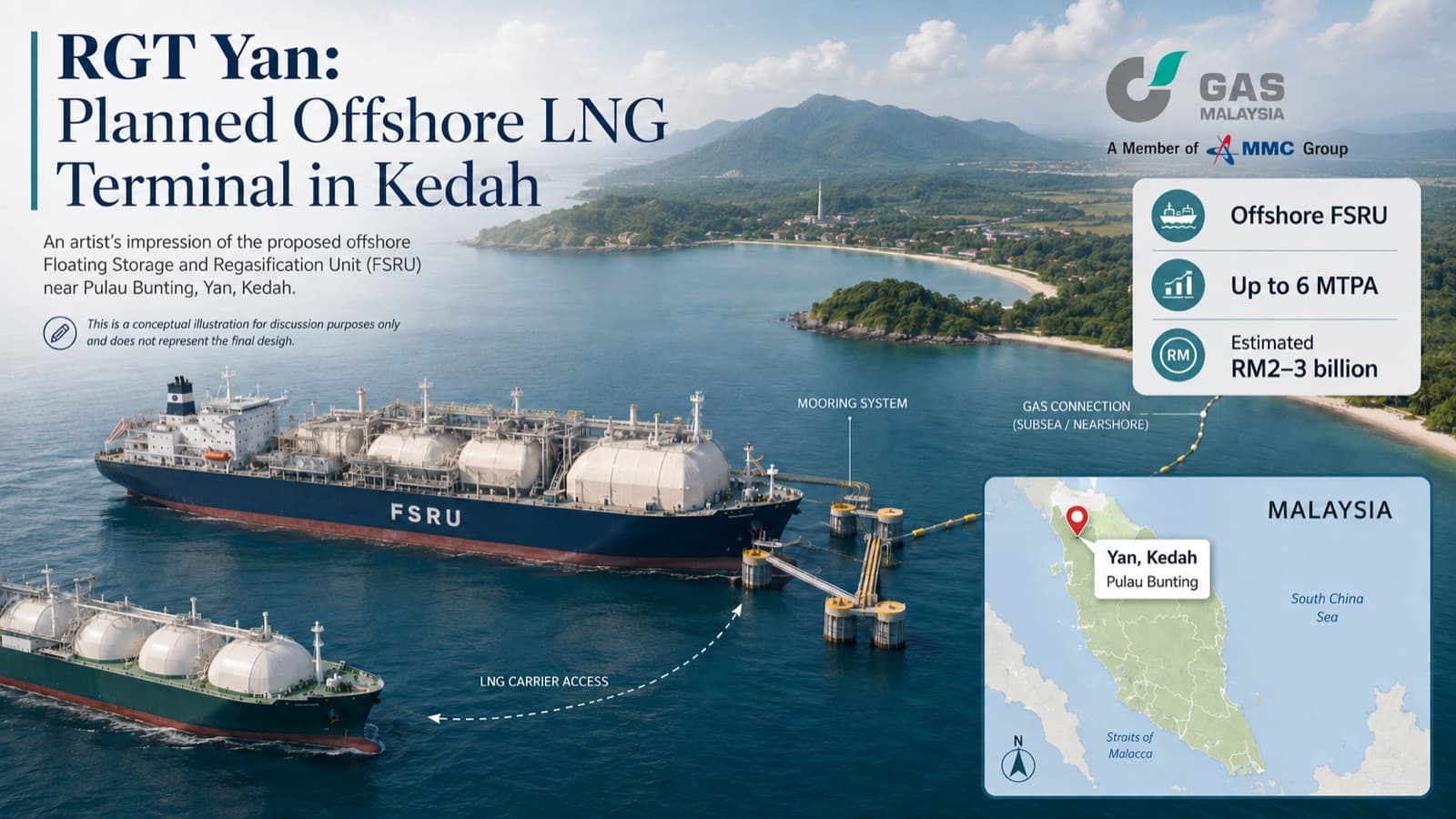
Gas Malaysia has moved its RGT Yan project into front-end engineering design. The terminal will sit offshore Pulau Bunting, off Yan in Kedah, and will import up to 6 million tonnes of LNG a year through a floating storage and regasification unit. Estimated cost is RM2 billion to RM3 billion, and the target for start-up is 2029.
The engineering headline belongs to Technip Energies, which holds the FEED and is running the work out of its Kuala Lumpur operating centre. The more consequential story is who is developing the thing.
A gas distributor is becoming a terminal owner
Gas Malaysia has spent its working life selling and distributing gas through the Peninsular Gas Utilisation network. It has never built or operated an LNG import terminal. Malaysia's two existing terminals, Sungai Udang in Melaka since 2013 and Pengerang in Johor since 2017, are both PETRONAS Gas assets.
RGT Yan is therefore not one more terminal on a list. It is a distributor moving upstream into the infrastructure it has always bought capacity from, and doing it as project lead rather than as a minority partner.
The consortium reflects exactly that. Tokyo Gas, a shareholder in Gas Malaysia since 1992, brings LNG procurement and receiving terminal experience. VTTI brings global terminal development and operations. The joint development agreement was signed in May. Gas Malaysia holds the lead, which means Gas Malaysia carries the owner's engineering, interface and delivery responsibility, and Gas Malaysia has to build a team capable of holding it.
Where the project actually stands
The Energy Commission issued a letter to proceed in March, which cleared engineering, financing progression and site preparation. That is not a final investment decision, and no FID date has been announced.
The FEED scope reflects a project still choosing its shape. Technip Energies is evaluating alternative terminal configurations before completing FEED on the selected one, then establishing the technical basis and supporting progression toward FID. In plain terms, the fundamental questions are still open.
That is worth stating precisely, because the unresolved list is long. The FSRU has no named provider, and no decision between a newbuild and a conversion. Storage volume, send-out capacity, mooring configuration, pipeline diameter and length, the tie-in point into the PGU network, and whether EPC goes out as a single award or as packages are all undecided in public. Anyone claiming to know is guessing.
What the scope will call for, and when
The confirmed scope has four parts, and they do not share a labour market. An FSRU with onboard regasification. Marine infrastructure for mooring and carrier transfer. A subsea gas pipeline to shore. An onshore receiving facility tying into the PGU network.
That combination is why the hiring pattern here does not follow the usual one. A project of this shape needs marine and naval people alongside process and pipeline people, working to the same interface register, and it needs them during concept selection rather than after it. The decisions that determine the cost of the next four years are being made in the room right now.
The owner team is the immediate demand, and it is the one people consistently expect too late. FEED is when an owner should be strengthening project management, not after EPC award, because the owner team is what reviews the contractor's work and holds the interfaces nobody else owns. Expect a project director, a senior project manager, engineering and project controls management, an FSRU manager, a marine manager, and pipeline and onshore facilities leads. Construction, commissioning and operations readiness follow later, but the people who define those roles are hired now.
The tighter constraint is arithmetic. RGT Yan is not the only Malaysian regasification project targeting the end of this decade. The planned RGT-3 at Lumut in Perak is aiming at a similar window. Two FSRU-based terminals, in one country, drawing on one pool of Malaysian and Singaporean LNG terminal, marine and commissioning experience, at overlapping times. There is no version of that where senior FSRU experience gets easier to find in 2027.
What we are watching
Concept selection is the next real milestone, because it converts an open question into a scope somebody can be hired against. FID follows, and with it EPC strategy, which decides whether this becomes one large contractor mobilisation or several smaller ones. Neither has an announced date.
Until then, the useful signal is not the press release. It is which disciplines the owner team recruits first, because that is the earliest honest indication of the configuration they expect to build.
Staffing a project like this one?
We deploy engineers across ASEAN energy, marine and power, and we can tell you who is available before you commit to a date.